
Termites

Termites are wood-eating social insects that live in colonies, and Florida has more established termite species than any other state. In South Florida, two invasive subterranean termites and the West Indian drywood termite cause most of the damage to homes, condos and trees, and each one is treated differently, so knowing which termite you have comes first.
- Since 1969Third generation, protecting South Florida
- 110% GuaranteeIf the bugs come back, so will Toro, at no additional cost
- Within 24 HoursResponse guaranteed
- Free InspectionPlus $25 off your first service
What Are Termites?
Termites are social insects that feed on cellulose, the main ingredient in wood, paper, cardboard and plant material. They live in colonies with different castes: workers that feed the colony and do the damage, soldiers that defend it, and reproductives, including the king and queen. Once a year or so, mature colonies release winged reproductives, called swarmers or alates, that fly out, shed their wings, pair up and try to start new colonies.
Florida is termite country. University of Florida researchers count about 20 established termite species in the state, more than any other U.S. state, and several of them are invasive species that arrived from abroad. South Florida’s warm, humid climate lets tropical termites survive outdoors all year. Irrigated lawns, lakes, canals and a long rainy season keep the soil moist for subterranean termites, while older homes, wooden furniture and boats give drywood termites plenty of dry wood to live in.
The problem is growing. A 2026 UF/IFAS study in the Journal of Economic Entomology, based on records from 1990 to 2025, found that the Formosan and Asian subterranean termites are still expanding their range with no sign of slowing, and that a 2016 forecast remains on track: about half of all structures in the urban South Florida metro area could be at risk from one or both species by around 2040. A 2025 UF study added another piece of the puzzle: recreational boats are a major pathway for spreading invasive termites, and South Florida, the “yachting capital of the world,” is a hot spot.
How to Identify Termites
Most people never see termite workers, which are pale, soft-bodied and stay hidden inside wood, soil or mud tubes. What homeowners usually notice are the swarmers, the damage or the droppings.
- Swarmers (alates): Winged termites about 10 to 15 mm long including the wings, depending on the species. They fly toward lights, then drop their wings, so piles of identical wings on windowsills are a classic clue.
- Soldiers: Larger heads and strong mandibles. Soldiers are the caste experts use to identify species. Invasive Coptotermes soldiers have an oval, teardrop-shaped head and release a white, glue-like droplet when disturbed.
- Damage: Subterranean termites leave soil packed inside galleries that follow the grain of the wood. Drywood termites leave clean, smooth galleries and push out dry pellets.
Termite swarmers vs. flying ants
Flying ants swarm at the same time of year, so they are the most common look-alike. UF/IFAS points to three differences:
- Antennae: straight and bead-like on termites, bent at an “elbow” on ants.
- Waist: termites have a thick, uniform body; ants have a pinched, narrow waist.
- Wings: termite wings are all the same length and much longer than the body; an ant’s hind wings are shorter than its front wings.
Do not rely on color. Both termites and ants range from pale to almost black. If you are not sure, keep a few insects or wings in a sealed bag or a vial with rubbing alcohol for identification.
Mud tubes vs. frass pellets
This is the fastest way to tell the two main groups apart. Mud tubes are pencil-width tunnels of soil and saliva running up foundations, walls, pipes or tree trunks; they point to subterranean termites, which must stay connected to moisture. Frass is small, hard, six-sided pellets, often tan to almost black, that look like sand or coffee grounds and collect below tiny “kick-out” holes; it points to drywood termites, which live entirely inside dry wood.
Termite Species in South Florida
Formosan Subterranean Termite
Coptotermes formosanus is an invasive termite from Taiwan and southern China, first found in Florida in the 1980s in Hallandale. Colonies can contain several million termites, build carton nests in walls and, in South Florida, can even live above ground in high-rise buildings.
Asian Subterranean Termite
Coptotermes gestroi is a tropical invader first recorded in the U.S. in Miami in 1996. It is restricted to southern Florida, swarms at dusk early in the year and is known for nesting in large living trees.
Drywood Termites
The invasive West Indian drywood termite (Cryptotermes brevis) lives only in buildings, furniture and boats and is the main reason homes in Florida are tented. Native drywood species mostly live in dead branches outdoors.
Eastern Subterranean Termite
The eastern subterranean termite (Reticulitermes flavipes) is native to eastern North America. It is found statewide in Florida, but in South Florida the invasive Coptotermes species are considered the most damaging, and in the Keys it is very rare.
Other Termites
UF/IFAS also tracks minor species with small ranges in South Florida, such as the invasive conehead termite (Nasutitermes corniger) in parts of Dania Beach, which is under an eradication campaign, and the West Indian subterranean termite (Heterotermes cardini) in small pockets of Miami and West Palm Beach.
In Miami-Dade and Broward, the Formosan and Asian subterranean termites live side by side, and UF/IFAS confirmed in 2025 that hybrid colonies of the two species are now established in South Florida. Each species page above covers how to recognize it and how it is treated.
Signs of a Termite Problem
- Swarms of winged insects indoors, especially near windows, light fixtures and sliding doors.
- Piles of shed wings on windowsills, floors or countertops.
- Mud tubes on foundations, slab edges, walls, plumbing or tree trunks.
- Small piles of gritty, six-sided pellets below wood trim, door frames, furniture or attic framing.
- Tiny round “kick-out” holes about 1 to 2 mm wide in wood.
- Paint or wood surfaces that look blistered, peeling or warped.
- Wood that sounds hollow or papery when tapped, or gives way when probed with a screwdriver.
- Soil packed inside damaged wood, or brown, sponge-like carton material inside walls.
Why Termites Are a Problem
The concern with termites is property damage, and it is usually expensive and hidden. Subterranean colonies of the invasive species can reach millions of termites and forage far underground, and drywood colonies can live inside a building’s wood for more than ten years. Because termites eat wood from the inside out, damage is often found only during a remodel or when a frame gives way. The 2026 UF study notes that subterranean termite damage is rarely reported before it is extensive.
The cost is large at every scale. UF/IFAS estimates that invasive termites cause tens of billions of dollars in damage and control costs worldwide each year, and that nearly all structural fumigation in Florida targets a single species, the West Indian drywood termite. Termites also threaten South Florida’s urban tree canopy: subterranean colonies can hollow out mature trees, which then become more likely to fall in a hurricane.
Where Termites Hide in South Florida Homes and Businesses
- Soil and slab edges: subterranean termites travel from the soil through gaps in the foundation, inside mud tubes or through wood touching the ground.
- Wall voids and under sinks: Formosan termites build carton nests in hollow spaces where plumbing leaks keep things damp.
- Roofs and upper floors: aerial colonies can live with no ground connection where roof leaks, AC condensate or flat roofs that pool rainwater provide moisture.
- Attics, door and window frames, trim and furniture: the favorite places for drywood termites, which need no soil or moisture source.
- Trees and landscaping: large live trees, stumps, mulch beds and wood fences near the house.
- Boats and marinas: infested vessels can release swarmers that start colonies on shore, a pathway UF/IFAS has documented in South Florida.
When Termites Are Most Active in South Florida
| Season | What termites are doing | What to do |
|---|---|---|
| December to February (dry, mild) | Colonies feed all winter; native subterranean termites can begin swarming; Asian subterranean swarms can start in late February | Schedule a termite inspection before swarm season and fix leaks and wood touching soil. |
| March to April | Asian subterranean termites swarm at dusk; drywood swarms begin; Formosan swarms start in late April | Turn off outdoor lights at dusk, keep windows and doors closed, and save wings for identification. |
| May to June (start of rainy season) | Peak Formosan swarms after sunset; West Indian drywood termites swarm | Check sills and light fixtures for wings and look for new pellet piles. |
| July to November (rainy and hurricane season) | Colonies grow and forage in moist soil and trees; storms damage roofs and trees that can hide colonies | Repair roof leaks quickly, inspect large trees after storms and remove debris from around the home. |
How to Prevent Termites
- Fix plumbing leaks, roof leaks and air conditioning condensate lines that keep wood or soil wet.
- Keep wood, including siding, fences and stored lumber, from touching the soil.
- Keep mulch and dense plants a few inches away from the foundation so you can see mud tubes.
- Turn off outdoor lights during swarm season when security allows, and keep windows and doors closed during swarms.
- Seal cracks around windows, doors and eaves, and use fine mesh screening on attic vents to keep drywood swarmers out.
- Inspect used furniture, antiques and wooden items for pellets before bringing them inside.
- Have large trees near the home checked for termites, especially before hurricane season.
- If you own a boat, inspect it regularly for wings, pellets or mud tubes.
- Schedule a professional termite inspection every year, since colonies are active year-round.
How Toro Gets Rid of Termites
- InspectionA trained Toro technician inspects the inside and outside of your home or business, including the slab, walls, attic, wood trim, landscaping and nearby trees, looking for mud tubes, frass, wings and damage.
- Species identificationSwarmers, soldiers, tubes and pellets tell us which termite you have. This step decides everything, because drywood and subterranean termites need completely different treatments.
- Targeted treatmentSubterranean termites are handled with termite baiting or soil treatment around the structure. Drywood termites are handled with tent fumigation or our TORO-GUARD non-tenting treatment, depending on how widespread the infestation is.
- Monitoring and follow-upWe monitor bait stations and treated areas and recommend prevention steps. Our 110% Satisfaction Guarantee means that if the bugs come back, so will Toro, at no additional cost to you.
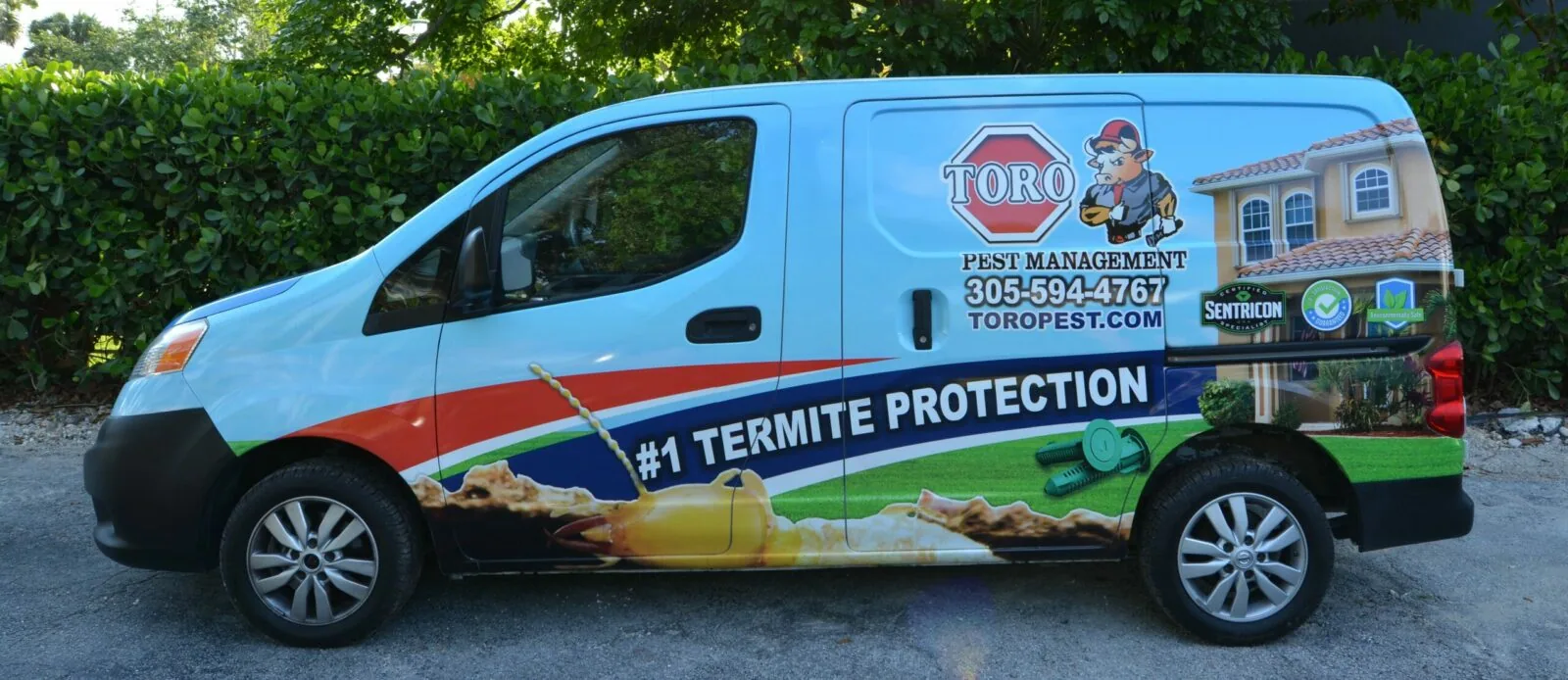
Toro Pest Management has protected South Florida since 1969, from Miami-Dade and Broward to Palm Beach and the Keys. Our technicians train at the TORO Institute at our Miami headquarters with on-staff entomologists, and we guarantee a response within 24 hours. Learn more about our termite control service or call 305-594-4767 for a free inspection and $25 off your first service. Hablamos Español.
Seeing signs of termites? Get a free inspection and $25 off your first service.
Schedule Your Free InspectionTermites: Frequently Asked Questions
What kind of termites are in South Florida?
UF/IFAS lists about 20 established termite species in Florida, but three cause most structural damage in South Florida: the Formosan subterranean termite, the Asian subterranean termite and the West Indian drywood termite. Native eastern and dark southern subterranean termites are also found in the state, and a few other species, such as the conehead termite in parts of Broward County, have limited distributions.
How do I know if I have termites?
Look for swarms of winged termites or piles of shed wings near windows and lights, pencil-width mud tubes on foundations or walls, small piles of six-sided pellets that look like coffee grounds, and wood that sounds hollow or has blistered paint. A single winged termite indoors may have flown in from outside, but wings in several rooms are a reason to schedule an inspection.
What is the difference between flying ants and termite swarmers?
Termite swarmers have straight, bead-like antennae, a thick waist and four wings of equal length that extend well past the body. Flying ants have elbowed antennae, a pinched waist and hind wings that are shorter than the front wings. Color is not a reliable way to tell them apart, because both groups vary from pale to dark.
When is termite season in South Florida?
Swarms can start in late February. UF/IFAS reports Asian subterranean termites swarming at dusk from about February or March to April, Formosan termites from late April into June, and West Indian drywood termites mainly from April to June. Colonies feed all year, though, so the swarm is only the most visible moment, not the only time termites are active.
Does tenting kill all termites?
Tent fumigation is used for drywood termites, which live entirely inside the wood of a building, and when done correctly it reaches every colony in the structure. It does not work for subterranean termites, because most of their colony lives in the soil outside the tent and can come back afterward. Subterranean termites are handled with baits or liquid soil treatments instead.
Can I get rid of termites myself?
UF/IFAS notes that over-the-counter products are unlikely to control the invasive subterranean termites, and soil treatments, baits and fumigation for these species must be applied by licensed professionals. Removing a small piece of infested wood can help with an early drywood problem, but identification comes first, because the right treatment depends entirely on the species.
Can termites damage trees in South Florida?
Yes. Asian and Formosan subterranean termites can nest inside large living trees, feeding on the dead wood at the center of the trunk. The tree may look healthy while it is hollowed out, and UF/IFAS research shows infested trees are more likely to break or collapse in hurricane winds. Colonies in trees can also forage into nearby buildings.
Related Pests
- Formosan Subterranean Termite
- Asian Subterranean Termite
- Drywood Termites
- Eastern Subterranean Termite
- Ants
- Silverfish
Pest Control Across South Florida
Toro treats termites in homes and businesses throughout Miami-Dade, Broward and Palm Beach counties, including:
- Miami
- Hialeah
- Doral
- Miami Beach
- Coral Gables
- Homestead
- Fort Lauderdale
- Hollywood
- Pembroke Pines
- Miramar
- Boca Raton
- West Palm Beach
Last updated: October 29, 2026

110% Satisfaction Guaranteed
If the bugs come back, so will TORO at no additional cost to you. TORO will respond with in 24 hours Guaranteed. Our technician will arrive quickly and deal with the pest problem to prevent recurrence.

