
Key takeaways
- Pavement ants are not dangerous to people: UF/IFAS notes they do not often sting humans, and they cause no structural damage.
- The true pavement ant is mainly a northern city ant; in South Florida, sandy piles along driveways and walkways are more often bigheaded ants.
- Bigheaded ants do not sting, but their lawn and landscape colonies often need treatment several times a year.
- If a small ant stings and leaves a white pustule, you are likely dealing with fire ants, which are a real health concern.
In this article
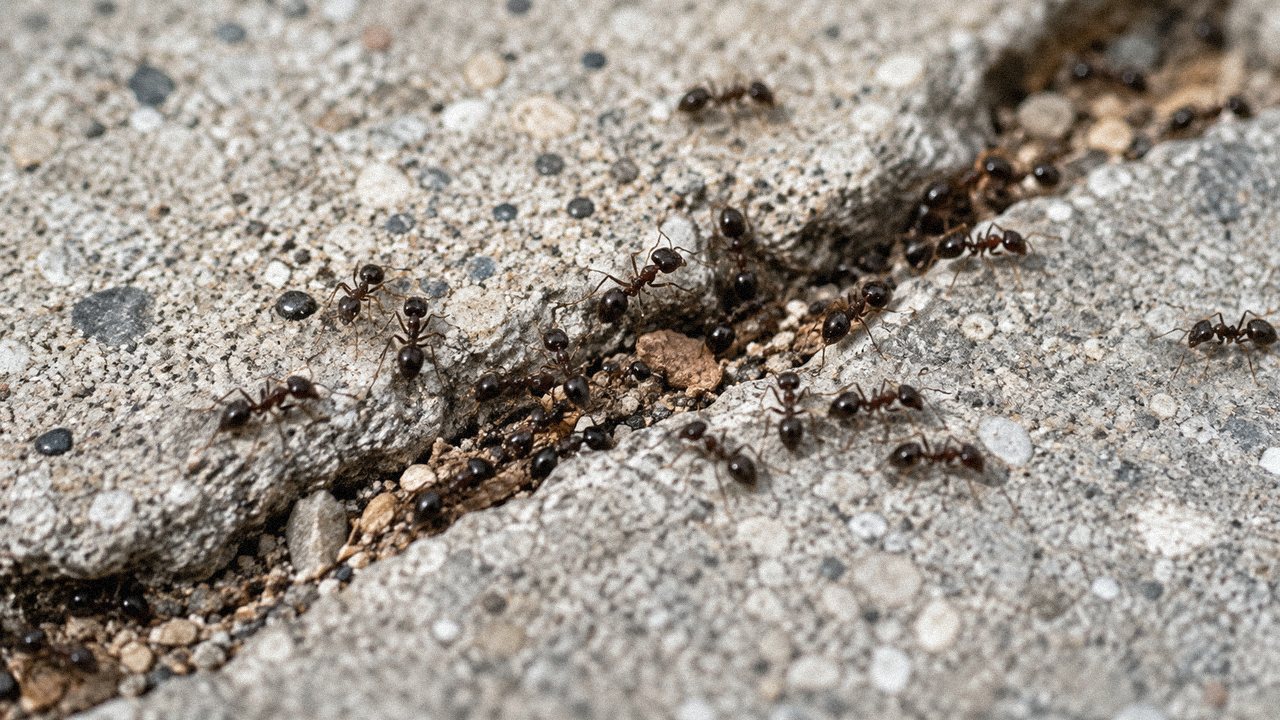
Pavement ants are not dangerous. They rarely sting people, they are not aggressive, and they do not damage concrete or wood. They are a nuisance pest: they trail into kitchens and garages, get into sweets, grease and pet food, and leave little piles of sand along cracks in sidewalks and slabs.
In South Florida there is a twist. The true pavement ant is mainly a northern city ant, so the “sand ants” piling dirt along your driveway or patio are more often a different species, the bigheaded ant. Neither one is dangerous, but the ant you do need to worry about, the fire ant, can look similar at a glance. This guide explains how to tell them apart, what risks each one carries and how to stop them.
What Are Pavement Ants?
The pavement ant, now called the immigrant pavement ant (Tetramorium immigrans), was brought to North America from Europe at the beginning of the 19th century. According to UF/IFAS, it is one of the most commonly encountered ants in the United States and is well established in urban areas of the Northeast, the Midwest and the Pacific Northwest.
Key traits:
- Size and color: Workers are about 2.75 to 3.2 mm long and dark brown to nearly black.
- Look closely: Fine parallel ridges on the head and thorax, a pair of small spines on the back and a two-segmented waist.
- Colonies: Often more than 10,000 workers, usually started by a single queen.
- Nests: In soil, with several crater-shaped entrances. The little mounds form after rain and slowly collapse, so they are not always obvious.
UMaine Extension adds that colonies live in the soil beneath floors, sidewalks and driveways and under stones or logs, and that workers can travel more than 30 feet from the nest to find food.
Pavement Ants vs. Bigheaded Ants and Fire Ants in South Florida
Small ants with sand piles near pavement are common across Miami-Dade, Broward and Palm Beach. Here is how the three likeliest suspects compare; our guide to ants in South Florida covers the other species.
| Feature | Pavement ant | Bigheaded ant | Fire ant |
|---|---|---|---|
| Color and size | Dark brown to nearly black, about 3 mm | Reddish-brown, about 2 mm, plus a few 3-4 mm workers with very large heads | Reddish-brown, 3-6 mm, mixed sizes |
| What you see | Small craters of soil at cracks, ants in long trails | Loose sandy dirt piles along walkways, driveways and lawn edges | Dome-shaped mounds in sunny lawns and along sidewalks |
| Stings | Rarely stings people | Does not sting; bite is not painful | Stings, often leaving a white pustule |
| Structural damage | None | None | None to wood or concrete |
| Danger level | Nuisance | Nuisance | Health risk, especially for allergic people |
Bigheaded Ants: South Florida’s “Sand Ants”
A UF/IFAS list of the most problematic pest ants in and near South Florida structures puts the bigheaded ant first, and according to pest control operators it has become the most pervasive nuisance ant in southern Florida, out-competing fire ants and other established ants in most areas. It has been confirmed in 17 Florida counties, including Broward, Miami-Dade, Palm Beach and Monroe.
The giveaway is loose, sandy soil piled along walkways, driveways and lawn edges. Bigheaded ants nest under bricks, pavers and flower pots, around trees and water pipes and along the base of buildings. They also build fragile, debris-covered foraging tubes that can look like termite mud tubes. If you are not sure which you have, our guide to termites vs. flying ants explains the basic differences.
Fire Ants: The One to Worry About
UF/IFAS describes imported fire ants as reddish-brown, 3 to 6 mm long, building large mounds in sunny areas, and able to sting, often causing a white pustule. They are the ant on this list that is truly dangerous. Learn how to spot them on our fire ant page, and see how they compare with other stinging species in Florida’s most aggressive ant species.
Need help with pests in South Florida?
Toro Pest Management has protected homes and businesses since 1969. Get a free inspection and $25 off your first service, backed by our 110% Satisfaction Guarantee: if the pests come back, so do we, at no extra cost.
Are Pavement Ants Dangerous to People?
No. The pavement ant does have a stinger, but UF/IFAS describes it as broadened into a triangular flag that is probably less effective for defense and better suited to laying trail pheromone. In the institute’s words, pavement ants “do not often sting humans.” UMaine Extension calls them very small, docile ants.
If you pick one up, you may feel a pinch, but there is no reason to fear a trail of pavement ants around children. If anyone in your home is stung repeatedly or develops swelling, hives or trouble breathing after a sting, assume it was a different insect and see a doctor right away.
Can Pavement Ants Damage Your Home?
They do not damage buildings. UMaine Extension states plainly that pavement ants cause no structural damage. They nest in the soil under slabs and enter through cracks that are already there, especially in foundations and concrete slabs. That is why garages, slab-on-grade kitchens and ground-floor condos see them first.
What they can damage:
- Food. Pavement ants eat sweets, meats, grains, bread and crackers, food scraps, pet food, nuts and other insects. Once foragers find an open box of cereal or a bag of dog food, they recruit hundreds of nestmates, and the food usually ends up in the trash.
- Gardens. When food is scarce, they can feed on sap and girdle young vegetable plants such as tomatoes, brassicas and carrots.
- Landscape plants. UF/IFAS notes that pavement ants feed on honeydew and can defend aphid pests, which can make plant pest problems worse.
They may even have a small upside: in lab experiments, pavement ants destroyed young red imported fire ant colonies, and they aerate soil and recycle nutrients.
When Pavement Ants Are Most Noticeable
UF/IFAS notes that colonies fight large territorial battles on sidewalks in spring and early summer, and that winged males and queens are produced in early summer for mating flights. Mounds also appear after rain. In South Florida, where the wet season runs from mid-May to mid-October, rain-soaked soil and summer heat are when you are most likely to see sand at cracks and ants moving indoors. For the bigger picture, see how concerned you should be if you find ants in your home.
How to Get Rid of Pavement Ants
Pavement ants share food among nestmates, which makes them good candidates for baits. UF/IFAS calls sealing entry points one of the most effective control methods and notes that liquid ant baits may reduce colony numbers.
- Identify the ant. Pavement, bigheaded and fire ants need different products and different timing.
- Bait, do not spray. Place bait beside active trails and at the cracks where ants come up. Do not spray insecticides or cleaners near the bait. UC IPM notes that fewer ants may appear within about 5 to 10 days, with full control taking several weeks.
- Clean the trail. Where you are not baiting, wipe trails with soapy water to remove the scent ants follow.
- Seal cracks. Once activity stops, caulk gaps in slabs, along the foundation and where pipes and wires enter.
- Remove the food. Store sugar, cereal and pet food in sealed containers, and keep garage recycling rinsed and closed.
For more ways to stop ants before they come inside, see our home ant prevention methods, and if the ants inside are tiny and black rather than brown, read how to get rid of little black ants.
When to Call a Professional
Bigheaded ants in particular are hard to control on your own. UF/IFAS reports that lawns and flowerbeds need treatment at least four to five times per year, that one-time treatments have very limited value, and that infested neighboring properties must be treated too or the ants come back.
Call a professional when ants keep returning after several weeks of baiting, when you see sand piles across the yard or ants inside in several rooms, or when you suspect fire ants near children or pets.
Toro starts with a free inspection to identify the ant and find the nests, then treats nests, trails and entry points with products chosen for that species and applied according to the label. For ants nesting in your lawn and landscape, our lawn spray service treats fire ants and other yard insects with power lawn sprays and granules, with follow-up visits to check the results. Toro has served South Florida since 1969 and responds within 24 hours, guaranteed.

Contact Toro today
A free inspection & $25 off your first service
A trained Toro technician inspects your home or business, explains what was found and gives you a clear plan and quote, backed by our 110% Satisfaction Guarantee.
305-594-4767Frequently Asked Questions
Do pavement ants bite or sting?
Are pavement ants harmful to dogs and cats?
Can pavement ants damage my concrete or foundation?
Why do I see ants fighting on my sidewalk?
What are the small ants coming out of cracks in my garage floor?
Sources
- Immigrant Pavement Ant, Tetramorium immigrans (EDIS IN1047), UF/IFAS Extension
- Pavement Ants, University of Maine Cooperative Extension
- Bigheaded Ant, Pheidole megacephala (EDIS IN712), UF/IFAS Extension
- Pest Ants (SP119), UF/IFAS Extension
- Ants: Pest Notes, University of California Statewide IPM Program
- South Florida Rainy Season Outlook 2025, National Weather Service Miami
Educational content. This article is for general information about pests in South Florida and is not medical, legal or professional advice. If you have a bite, sting or allergic reaction, contact your doctor; in an emergency, call 911. Pest problems vary from home to home, so a licensed professional should inspect before treatment. When using any pesticide, always read and follow the product label.


